"We Won't Talk to the Mechanic": A Victim Who Said the Attackers Had the Wrong Company

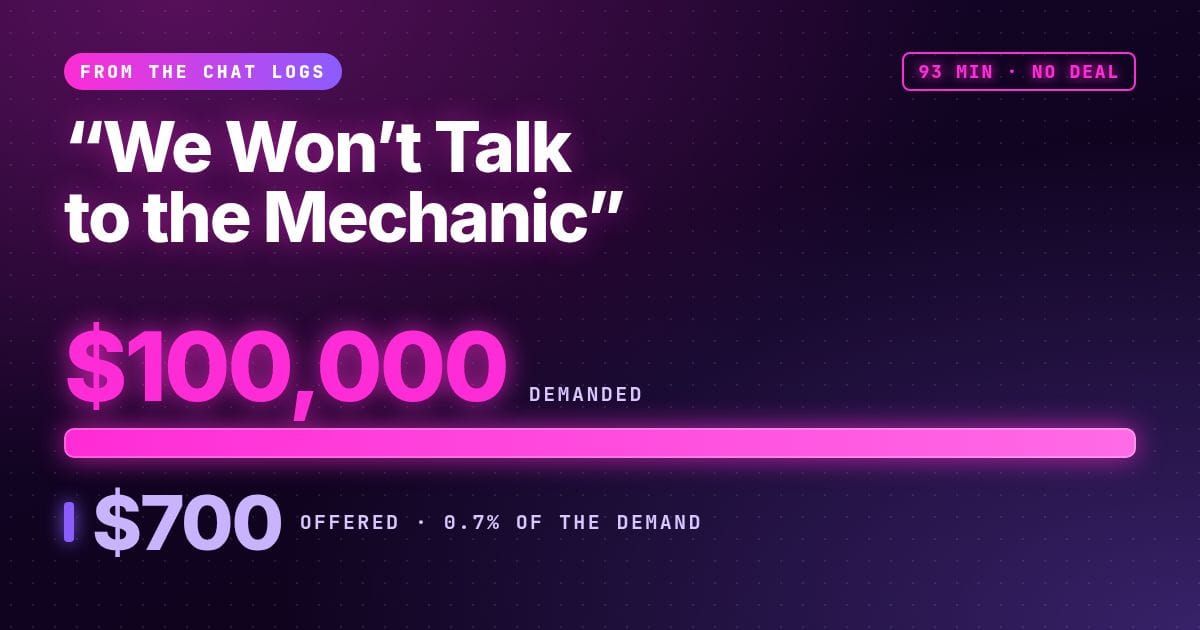
A 93-minute ransomware chat in which a self-described one-family truck-repair shop insisted it was not the company the attacker had profiled, offered $500 and then $700, and was told: "Sorry we can't help you".
Most ransomware negotiations are an argument about a number. This one is an argument about identity.
Within twenty-five minutes of the first message, the person typing on the victim side had told the attackers they fix trucks, that a close friend had died the day before, that they were buried in debt, and that their entire business did not make $100,000 a year. The attackers answered with a link to a business-data profile showing $5.4 million in annual revenue. The victim's reply: "thats not me friend".
The rest of the chat is a contest between two stories. In one, a small repair shop has been caught in an attack on a bigger company it does work for. In the other, that bigger company is pleading poverty through a mechanic's voice. The transcript cannot tell us which is true. It can show us how each side played its story, and why the conversation ended 93 minutes after it began with no deal, no discount and no decryptor. In the quotes below, that bigger company appears as [the larger company].
The Opening: A Plea Before a Price
The victim makes first contact and sends four messages before anyone answers. None of them is a question about price:
"hello. i am not sure what to do. or what to say" / "we fix trucks. our systems are locked" / "we are not a big company. i dont even know what i can offer you. please help us."
The gang replies five minutes later with the standard opening package: a 3.5 MB listing of the stolen files, an offer to send back two files of the victim's choice as proof of theft, and two free test decryptions. A few minutes later it sends a five-item menu: decryption, "evidence of data removal", a security report, guarantees not to publish or sell, and a promise not to attack again.
The victim's response to the menu is to argue that most of it is worthless:
"the data really is meaningless to anyone but me. if it could be sold, i would sell it myself and retire. lol. i just need to get the server back up."
It is a sensible move in principle. It tells the attacker that the leak threat has little value and that only the decryptor matters. But it arrives in a stream of disclosures that hand the attacker the victim's whole position. Over the next eleven minutes the victim writes that they are "not a computer guy", that a good friend "passed away" the day before, then:
"i am buried in debt." / "i have no leverage"
The gang, meanwhile, recasts the attack as a service it is owed for: "We just provide you Service of penetration your network system and just find "holes" you pay for this service to secure in the future your business". Twenty-three minutes after first contact, it names the price: "$100 000".
The Turn: A Revenue Profile
The victim reacts with disbelief ("my entire business doesn't make that in a year!" and "100k is my yearly salary if i am lucky"). Forty-seven seconds later the gang pastes a link to a company profile on a commercial business-data site, and states the number it found there:
"you have 5.4m$ revenue" / "per year"
This is the most useful moment in the transcript for defenders. The demand of $100,000 works out to about 1.9% of that published revenue figure.* At this point the attacker does not point to bank balances, insurance or anything in the stolen files. It points to a third-party data aggregator. In this chat, a public revenue estimate is the pricing sheet.
The victim's answer opens the identity dispute that runs to the end of the chat:
"thats not me friend" / "i wish" / "thats our competition" / "i actually know that company, i was once affiliated with them" / "almost makes me feel like they are somehow a part of this"
The gang does not argue. It presents evidence. All the documents it holds, it says, "associate with" [the larger company]'s web domain. The Windows domain of the encrypted network carries [the larger company]'s name. Then it uploads a PDF whose file name suggests an account statement (inferred from the file name; the chat does not show the contents).
The victim's story shifts as the evidence piles up. Calling [the larger company] "our competition" becomes "im connected to [the larger company], but i am not them", and later "the other company you are referring to uses us to do some of their work, but i am NOT them". Each version may be true at once: a small contractor working on a client's network would see that client's domain and files. But to the attacker each revision reads as a retreat.
The Middle: $500, "Not Interesting"
Fourteen minutes after the demand, the victim puts its first figure of its own on the table:
"i have 500 dollars in my checking account." / "facts" / "im a mechanic"
The gang's reply is "it is not our problem". The victim tries to frame it as a negotiation ("is something better than nothing?"), and within a minute the attacker sends "tell it leadership of [the larger company]" and then:
"500 dollar it is not interesting for us"
The victim then does something negotiators usually avoid. It states its walk-away option plainly and attaches a price to it:
"what is a number that is realistic and something that we can actually make happen?" / "for 100k, i would just throw away everything and start over" / "its not worth that to me"
In a chat with real leverage on the victim's side, that could have been a strong signal: the decryptor is worth less to us than rebuilding. Here it changed nothing. The gang's next message was the line that gives this post its title:
"Call the boss over here, we won't talk to the mechanic."
The End: The Boss of the Other Company
The victim insists they are the boss ("my son is next to me. we are the company. there is 2 other guys, they were sent home"), objects to being made to "sound like some type of peasant", and appeals again to the death of a friend. The gang mocks the offer ("lol if you boss and have 500 dollars in your wallet so it is very bad business man") and asks for the shop's own website. The victim says it has none.
The gang then posts something the archive has redacted, followed by the caption "This is boss of [the larger company]". From the caption, the redacted item was most likely a name or image identifying an executive (inferred). The victim answers that they had thought his name was something else, "but i really am not sure", and later names the owner (also redacted in the archive). The victim says again that at $100,000 they "will just delete everything and start over". Two minutes later, the friend who died the day before becomes "my friend and partner".
The gang then states where its leverage now lies, and it is not with the shop:
"negotiate with 500 dollars?" / "no thank you" / "we will wait untill [the larger company] will enter to this chat because their files we have" / "and if they don't enter to this chat, we will public all files that we have and after [the larger company] will close"
The victim makes one final move, raising its own offer by 40%:
"i can offer you 700. that is really all that i have liquid available to me. i dont even know how i would send it to you, but it is what i can offer you."
Five minutes later, the gang sends the chat's last message:
"Sorry we can't help you"
The transcript records no payment, no decryptor, no test decryption (the victim never uploaded files) and no proof of deletion. It also records no leak-site post or countdown. The threat to publish is aimed at [the larger company], and the chat ends with the gang waiting for that company to show up.
What This Transcript Teaches
Your public footprint is the attacker's price list. The gang's first and only justification for the price was a revenue estimate pasted from a business-data site, not insurance or anything from the stolen files. Defenders, and companies that might become victims, should know what aggregators say about their revenue and headcount, because the attacker will read it first.
A claim the stolen data contradicts is spent in minutes. "thats not me" held for about three minutes before the gang answered with the network's domain name, the provenance of the documents and an uploaded statement. Whatever the truth, a victim who contests facts the attacker can see in its own loot loses credibility for everything that follows, including the claim of poverty.
An offer below the attacker's floor ends the conversation. In many chats an early lowball starts the haggling. Here, $500 (0.5% of the demand) and then $700 produced no counter at all. The gang never moved off $100,000. The attacker judged that the money it wanted lived elsewhere and stopped spending time on the shop.
Disclosure is not a strategy. Within the first hour the victim volunteered grief, debt, "i have no leverage", and a walk-away point. Some of that may have been deliberate, and "its not worth that to me" is a legitimate signal. But unprepared, unfiltered disclosure gave the attacker the victim's whole position without getting anything back. A negotiator working from a plan would have chosen which of these facts to share, and when.
Emotional appeals did not move this attacker. The friend's death, the son beside the keyboard and "i am an honest man" all drew either silence or mockery. The gang's tone stayed transactional throughout, and its only flexibility, a change of target, came from evidence.
Shared IT means shared exposure. If the victim's account is true, a small contractor's machines sat on, or next to, a client's network and domain. One intrusion then encrypted the contractor's business and exposed the client's files. Inferred, but worth checking in any organization: which partners' systems share your domain, credentials or file stores?
Get help before you type. Nothing in the chat suggests an incident-response firm, counsel or a plan behind the keyboard (inferred). The victim describes a son who knew "enough to get me here". Even a small business can call its insurer, a local IT provider or law enforcement before the first message, and the first 93 minutes of this chat show what it costs to improvise.
The Wrong Room
Most negotiation transcripts are about how far an attacker will come down. This one shows the opposite: an attacker that decided, on the evidence, that it was talking to the wrong person, and was willing to walk away from any money the right person could not pay. The gang's last threat was not addressed to the shop at all.
Whether the shop was a bystander caught in a client's breach or a bigger company playing small, the result for the victim was the same: locked systems, no decryptor, and a chat that closed in an hour and a half. For defenders, the lesson is to know before an incident what the attacker will believe about you, and how you will prove what is true.